

Abstract
Rationale Despite a long history of use in synaptic physiology, the lobster has been a neglected model for behavioral pharmacology. A restauranteur proposed that exposing lobster to cannabis smoke reduces anxiety and pain during the cooking process. It is unknown if lobster gill respiration in air would result in significant Δ9-tetrahydrocannabinol (THC) uptake and whether this would have any detectable behavioral effects.
Objective The primary goal was to determine tissue THC levels in the lobster after exposure to THC vapor. Secondary goals were to determine if THC vapor altered locomotor behavior or nociception.
Methods Tissue samples were collected from muscle, brain and hemolymph of Homarus americanus (N=3 per group) following 30 or 60 minutes of exposure to vapor generated by an e-cigarette device using THC (100 mg/mL in a propylene glycol vehicle). Separate experiments assessed locomotor behavior and hot water nociceptive responses following THC vapor exposure.
Results THC vapor produced duration-related THC levels in all tissues examined. Locomotor activity was decreased (distance, speed, time-mobile) by 30 min inhalation of THC. Lobsters exhibit a temperature-dependent withdrawal response to immersion of tail, antennae or claws in warm water; this is novel evidence of thermal nociception for this species. THC exposure for 60 minutes had only marginal effect on nociception under the conditions assessed.
Conclusions Vapor exposure of lobsters, using an e-cigarette based model, produces dose-dependent THC levels in all tissues and reduces locomotor activity. Hot water nociception is temperature dependent in the lobster, but no clear effects of THC inhalation were confirmed.
Competing Interest Statement
La Jolla Alcohol Research, Inc (LJARI) engages in commercial development of vapor inhalation techniques and equipment, including with support from the R44 DA041967 SBIR grant. LJARI donated funds for some of the lobster purchases but was not directly involved in the design of the experiments, analysis and interpretation of data or the decision to submit the study for publication.
Pain News Network reports
Medical Cannabis No Help to Lobsters
By Pat Anson, PNN Editor
Do lobsters feel pain when they’re boiled alive?
Seafood lovers, cooks, academics, animal rights activists and even governments have debated that question for years, with the general consensus being that they do. Lobsters, crabs and other crustaceans will often writhe in pain and try to escape when dropped into a pot of scalding hot water. The practice is considered so cruel that Switzerland and New Zealand made it illegal to boil a live lobster.
Some cooks try to ease the lobsters’ pain by stunning them with a jolt of electricity or putting them on ice to dull their senses before cooking them. In 2018, a restaurant owner in Maine even blew marijuana smoke on a lobster named Roscoe, who reportedly grew so mellow he never wielded his claws as weapons again while in captivity.
We’ll never know the long-term effect of getting a lobster stoned because Roscoe was returned to the ocean as a thank you for his service. Good for him.
Which brings us to a bizarre study recently completed by scientists at the University of California San Diego and the Scripps Research Institute, who decided to replicate the Roscoe experiment in a lab.
“The 2018 minor media storm about a restaurant owner proposing to expose lobsters to cannabis smoke really was the starting point. There were several testable claims made and I realized we could test those claims. So we did,” lead author Michael Taffe, PhD, an adjunct professor at Scripps Research told IFLScience.
Taffe and his colleagues purchased ten Maine lobsters at a local supermarket, fed them a last meal of frozen krill and fish flakes, and placed them in an aerated vapor chamber.
For the next 30 to 60 minutes, the lobsters were exposed to vapor rich in tetrahydrocannabinol (THC), the psychoactive ingredient in cannabis.
Afterwards, some of the lobsters were “rapidly euthanized” with a kitchen shear and dissected, while others were immersed in hot water to see how they’d react.
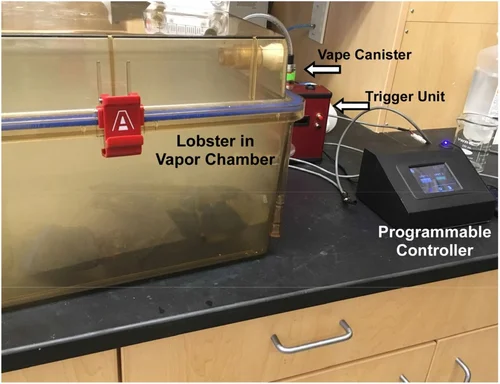

Detectable levels of THC were found in the muscles and organs of the euthanized lobsters, so from that standpoint the experiment was a success. But the THC apparently had little effect on the remaining live lobsters, who displayed “distinct motor responses” and other signs of pain when put in hot water.
“The effect of vapor THC on this nociceptive (pain) behavior was very minimal. Statistically supported in one case, but of very small magnitude,” said Taffe.
We’ll leave it to readers to decide whether a study like this is humane, worthwhile or even makes sense. But it is worth noting that taxpayers helped pay for it.
The lobster cannabis study was supported by grants from the U.S. Public Health Service. Researchers were careful to note that federal funding was not directly used to purchase the lobsters. That money came from La Jolla Alcohol Research, a private company that is developing vapor inhalation technologies. According to GovTribe, La Jolla Alcohol Research has received about $3 million in federal funding in recent years, most of it coming from the National Institute on Drug Abuse.
https://www.painnewsnetwork.org/stories/2021/6/12/medical-cannabis-no-help-to-lobsters